Roland Ennos allows readers to better understand trees and their structure by answering questions that include: How did trees evolve? How do they stand up? Why are there so many different types? How and why do we use them? He also explores the evolution of the first trees to the enormous diversity of tree life today. Illustrated with more than 120 stunning color images from around the world. Trees provides fascinating insights into the biology of these magnificent plants.
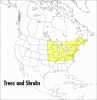
All the wild trees, shrubs, and woody vines in the area north to Newfoundland, south to North Carolina and Tennessee, and west to the Dakotas and Kansas are described in detail.
Profiles fourteen famous trees, from Hyperion, a redwood taller than the Statue of Liberty, to "Moon Trees," grown from seeds that travelled to the moon on Apollo 14.
Sophie's is hurt when the other children laugh at her painting of her favorite tree--but when she explains her painting everybody understands what she was trying to do.
Follows the story of a single tree through the changing of the seasons from fall to winter, as people, animals, and vehicles pass in front of the tree, celebrating holidays, playing in the leaves, and building nests. Includes blended words.
In the fall of the year, which is called autumn, the weather gets cooler. When the weather gets cooler, the leaves turn colors. Green leaves turn to shades of yellow and red. The leaves slowly fall until the trees are bare. This beginner reader has captivating photographs and age-appropriate text. It shows early readers how beautiful autumn is and how much fun raking leaves and jumping into the piles can be.
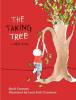
The Taking Tree is not happy when the boy takes first its twigs, then its apples, and then its branches to build a house he burns for the insurance money, and when the boy asks for even more, the Tree decides it is time to get even.