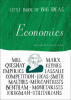
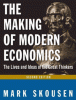
Discusses fifty of the most influential thinkers in the world of economics and ten economic schools of thought focusing on micro-economics and the philosophies of free trade.
Presents a complete and unabridged volume of eighteenth century Scottish economist and scholar Adam Smith's treatise on the defense of capitalist economics, originally published in 1776, and contains an outline of the fundamental concepts of modern economics.
This book examines how limited resources influence a country's economy discussing trading, production, gross domestic product, pricing, demand, and poverty.
What constitutes the good life? What is the true value of money? Why do we work such long hours merely to acquire greater wealth? Arguing from the premise that economics is a moral science, this book traces the concept of the good life from Aristotle to the present and shows how our lives over the last half century have strayed from that ideal.
The opening of economic borders in the early 1980's and the promotion of European free trade after 1990 helped the reconstruction of Eastern Europe and globally lifted 800 million people out of poverty. Behind this unprecedented growth is not only the collapse of state socialism but also a scientific revolution in economics. The recent economic crisis calls for a new commitment to the free-market society, not abandonment, according to the author.